Best Spotting Scope for Birding UK: A Practical Buyer's Guide
The best spotting scope for birding is the one that stays bright enough, steady enough and portable enough at the sites you actually visit. For fixed hides and dull weather, an 80 mm angled scope may suit; for long walks, a smaller model may be the wiser compromise. Always budget for suitable support.
A serious hide observer needs a shortlist that reflects actual sites, not a single league table. Distant waders on a grey morning, a seawatch in wind and a long walk to a viewpoint place different demands on the same kit. Decide where the scope will spend most of its time before comparing brands or maximum zoom.
Define “best” by your most common birding day
| Typical use | Priority | Likely compromise |
|---|---|---|
| Fixed hide or reservoir viewpoint | Brightness, comfort and stable support | A full-size body and tripod are easier to accept. |
| Estuary or seawatch | Usable detail, weather sealing and wind stability | Maximum zoom may still be limited by haze, rain or vibration. |
| Long reserve circuit | Complete carried weight and quick setup | A smaller objective may be used more often than a brighter heavy scope. |
| Shared family or group viewing | Easy handover and adaptable eyepiece height | An angled body may take longer to aim at first. |
WWT's practical guide describes binoculars as the portable scanning tool and a spotting scope as the option for distant detail and sharing a fixed view. It also recommends trying optics before buying and investing in secure support. Those are better starting rules than assuming every keen birder needs the largest lens.
Compare usable magnification, not the largest number
A 20–60x zoom gives a broad operating range, but every step up makes a narrow field and small vibration more obvious. Begin at 20x to acquire the subject. Move higher only if the view reveals more detail rather than a larger blur. Atmospheric shimmer, drizzle and low contrast can make a lower setting the more informative choice.
Field of view matters because a distant bird is no use if you cannot find it. Compare the maker's figures at both ends of the zoom, then practise moving from a binocular landmark to the scope. A smooth focus control and predictable tripod head can matter more in the field than another few units of magnification.
Choose objective size with the tripod attached
A larger objective has the physical potential to collect more light, but glass quality, coatings and magnification also affect the view. Full-size 80 mm bodies can make sense for long sessions from a fixed position. Compact 50–65 mm scopes reduce the carrying and support burden. Compare complete systems: body, eyepiece, plate, head, legs, case and water.
The Opticron telescope guide explicitly advises testing the complete kit when walking any distance. It also notes that there is no substitute for side-by-side eyepiece testing where possible.
Angled versus straight is a workflow decision
- Angled: often permits a lower tripod, relaxed downward view and easier sharing between different heights.
- Straight: often gives a more direct line for aiming at eye-level movement or using from a vehicle.
- Rotating collar: can place an angled eyepiece to the side in a hide, but check that the lock is easy to use.
Neither design removes the need for a stable seat and support. Spectacle wearers should test eye relief with their normal glasses at more than one magnification.
Weather claims need precise reading
“Waterproof” and “fogproof” should be supported by the manufacturer's description, but they do not mean maintenance-free. Dry the exterior after wet use, remove grit before wiping glass and store the scope with caps fitted in a dry place. Salt spray and sand need especially careful handling according to the maker's instructions.
A five-minute shortlist test
- Read a fixed sign at low, middle and maximum zoom without changing the support.
- Find a moving subject at low power, then refocus without losing it.
- Use the scope seated and standing, with glasses if applicable.
- Operate every lock and focus control with the hands you normally use.
- Lift the packed scope and tripod together, then walk a realistic distance.
WWT currently advertises hands-on optics events where models are set up on tripods. Availability changes, so check the event page rather than travelling on the strength of this article.
Crossfire HD 20-60x80 as one worked example
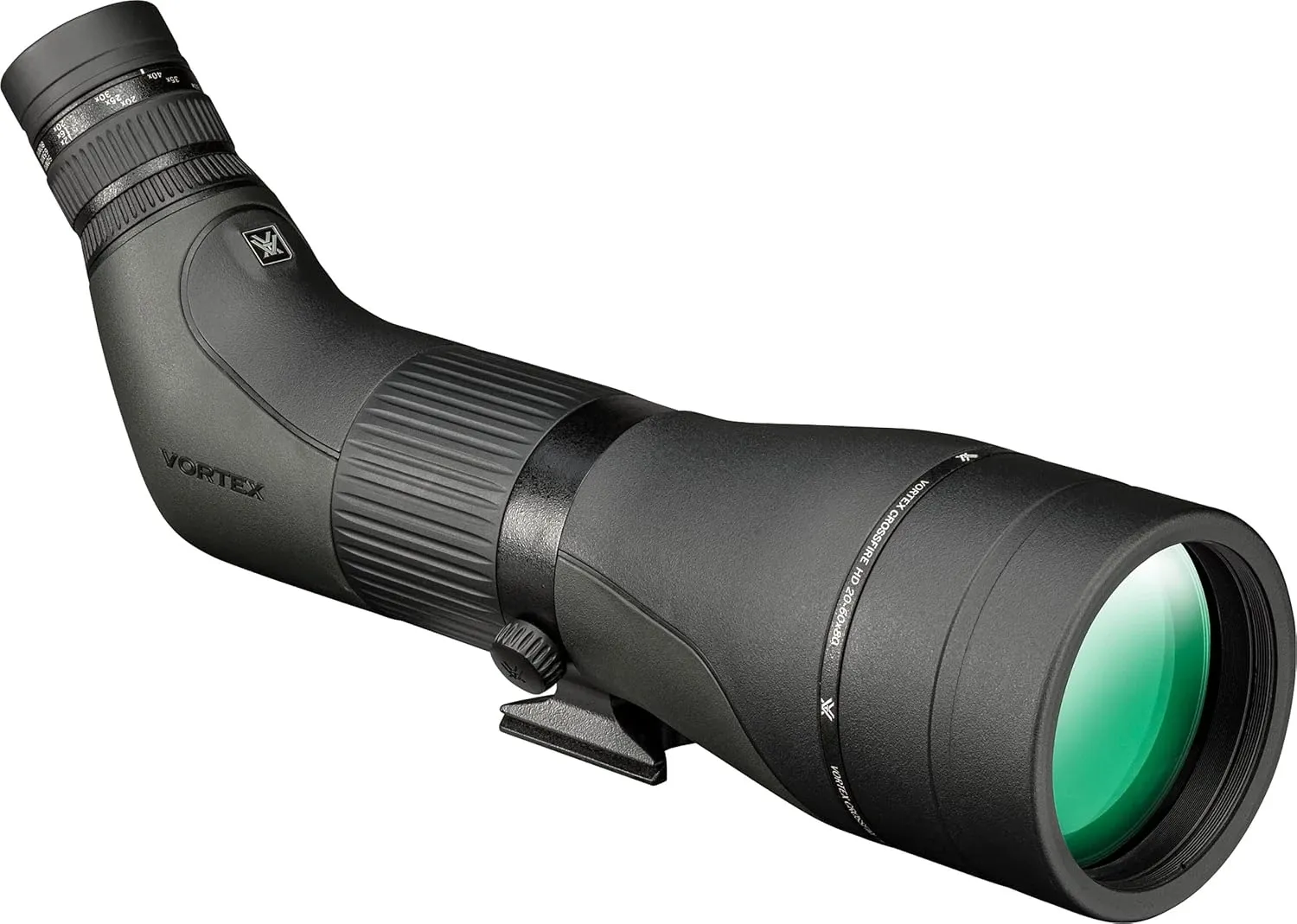
The official Vortex CF-80A page lists 20–60x magnification, an 80 mm objective, 18.0 mm eye relief, a 2.0°–1.0° angular field, waterproof and fogproof construction, Arca-Swiss compatibility and a 53 oz weight. That combination points to a full-size, tripod-led choice for hides and viewpoints rather than a compact walking scope.
The current Vortex Opti listing showed £290.57 on 20 July 2026. That price is not a recommendation. Compare the exact model, included items, warranty route and return terms on the day you buy. For the evidence and caveats specific to this model, read the Crossfire HD 20-60x80 review.
The honest boundary
No specification sheet can establish edge sharpness, colour fidelity, focusing feel or your tolerance for weight. This guide has not independently compared candidate scopes in controlled optical testing. A smaller model that you carry and use is a better choice than a theoretical winner that stays at home.
Continue with the next decision
- Comfortable angled-scope hide setup
- Spotting scope vs binoculars decision
- Crossfire HD 20-60x80 specification-led review
Frequently Asked Questions
What magnification is useful on a birding spotting scope?
A zoom such as 20–60x is flexible, but the lower and middle settings are often easier for finding birds and retaining brightness and field of view. Maximum power is useful only when the light, atmosphere, optics and support allow a genuinely clearer view.
Is an 80 mm spotting scope better than a 65 mm scope?
It can gather more light if optical quality and transmission are otherwise comparable, but it is also usually larger and heavier. An 80 mm body can suit a fixed hide or viewpoint; a 50–65 mm body may be used more often on long walks.
Should birders choose an angled or straight spotting scope?
Angled scopes can allow a lower tripod and easier sharing, while straight scopes can be quicker to align and may suit vehicles or eye-level subjects. The best choice is the one you can aim, focus and view comfortably in your normal setting.
What should I budget for besides the spotting scope?
Include a suitable tripod or hide mount, a head that moves smoothly, a quick-release plate if required, protective caps or cover and a safe carrying method. A high-quality scope on unsuitable support is not a complete birding setup.
Check the current Crossfire HD details and terms
View current product details — £290.57