Vortex Crossfire HD 20-60x80 Review UK: Specification-Led Verdict
This is a specification-led Vortex Crossfire HD 20-60x80 review, not a claim of independent optical testing. Its verified 20–60x zoom, 80 mm objective, angled body and 1.50 kg weight suit supported, mostly stationary viewing better than lightweight walking. Buy only after checking tripod capacity, UK warranty route and the retailer’s current returns terms.
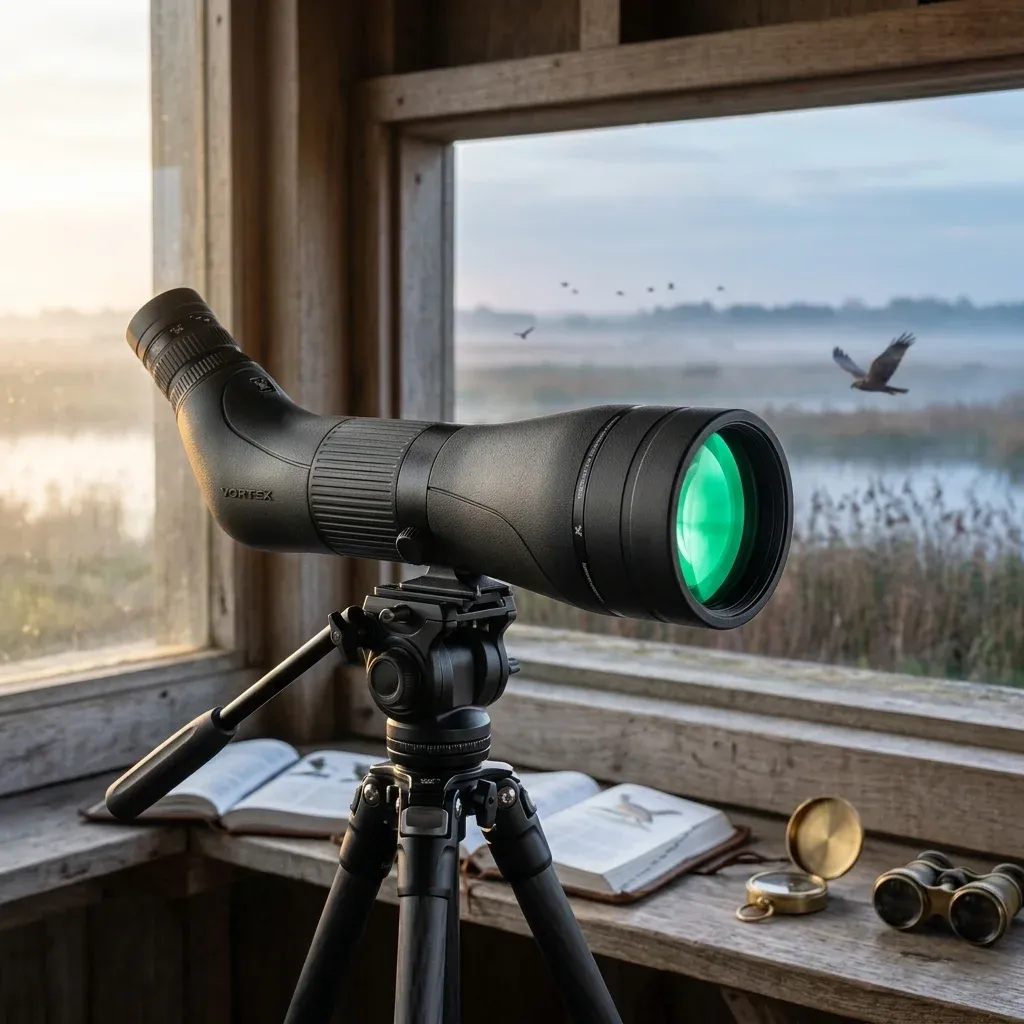
A buyer comparing a near-£300 scope with much dearer optics needs facts separated from sales language. This page checks the current manufacturer's specification for the angled CF-80A and asks what that specification means for UK birding. It does not report a laboratory measurement, a long-term field test or a head-to-head result against Swarovski, Zeiss or any other brand.
Review method and evidence boundary
The primary source is the official Vortex Crossfire HD 20-60x80 angled page, checked on 20 July 2026. Practical interpretation is cross-checked against WWT and Opticron guidance. Retail price and policy wording come from the live Vortex Opti pages and can change. Where the retailer and manufacturer differ, this review identifies the discrepancy rather than blending the figures.
Verified CF-80A specifications
| Item | Manufacturer listing | Decision meaning |
|---|---|---|
| Magnification | 20–60x | Low power helps acquisition; the top end demands light and stable support. |
| Objective | 80 mm | Full-size light-gathering potential, with added bulk. |
| Eye relief | 18.0 mm | A useful screening figure for glasses, but personal testing remains necessary. |
| Angular field | 2.0°–1.0° | The view narrows as magnification increases. |
| Linear field | 105–53 ft at 1,000 yd | Compare both ends of the zoom with alternatives. |
| Close focus | 26 ft | This is primarily a mid- to long-range optic, not a close garden specialist. |
| Length | 15.6 in (about 39.6 cm) | Allow room in the bag and on a hide shelf. |
| Weight | 53 oz (about 1.50 kg) | Add tripod, head and case before judging portability. |
| Mounting | Tripod adaptable; Arca-Swiss compatible | Confirm the exact clamp and safety arrangement. |
| Weather construction | Nitrogen purged, O-ring sealed, waterproof and fogproof | Useful outdoors, but still dry and store the optic correctly. |
Vortex lists a neoprene cover, tethered objective and ocular covers, and a lens cloth in the box. The official page calls the optical system “HD” and describes fully multi-coated lenses. It does not publish an independent transmission percentage on that page, so this review does not turn “HD” into a measured brightness or sharpness score.
Birding fit: where the design makes sense
The combination of an angled body, 80 mm objective and 1.50 kg body is most coherent for a hide, reservoir edge, estuary viewpoint or other mostly stationary session. At 20x, a wider field should make initial acquisition easier than at 60x. The angled eyepiece may also allow a lower tripod and easier sharing.
Opticron's scope guide supports those ergonomic principles, while WWT emphasises that a spotting scope depends on secure support. Neither source proves how this individual sample performs optically. A high-quality tripod and smooth head are part of the purchase decision, not optional extras to consider later.
Portability is the clearest compromise
Fifty-three ounces is before the head, legs, covers, bag, water and other field equipment. A birder who walks a long reserve circuit may get more use from a smaller objective even if it gives up some low-light potential. The full-size Crossfire makes more sense when the approach is short and the observation session is long.
The 18.0 mm eye-relief figure is promising enough to test with spectacles, but it cannot guarantee the full field for every face and prescription. Try low and high magnification, because eyecup position and field perception matter more than a number in isolation.
Price and value without a false premium comparison
The Vortex Opti detail page displayed £290.57 on 20 July 2026. Treat that as a dated observation, not a permanent offer. Compare the exact CF-80A, included cover and caps, delivery total, return conditions and the support route. Do not compare this model with a premium scope solely by objective size or zoom range; optical performance, mechanics and service cannot be reduced to those two numbers.
The site's product copy also contains ratings, savings and retailer comparisons that this article has not independently substantiated. They are not used in this verdict. The decision rests on manufacturer-listed facts, fit and the buyer's own trial.
Warranty route needs written confirmation
Vortex's international dealer page says the Worldwide Lifetime VIP Warranty is handled through the distributor or dealer in the country of purchase; service in another country may involve charges. The Vortex Opti product page separately displays a 12-month warranty. Before paying, ask the retailer to confirm in writing which UK distributor or dealer handles a claim and how the two statements interact.
Verdict: who should shortlist it?
- Shortlist it if you mainly observe from fixed positions, want an angled full-size body, already plan suitable support and can try the controls and view.
- Compare a smaller scope if long walks and quick setup dominate your birding.
- Do not choose on this review alone if top-end resolution, colour control or edge sharpness decides the purchase; those require a direct optical comparison.
- Pause the purchase if the warranty route, current returns terms or exact tripod fit cannot be confirmed.
The current product page remains the place to check live price and terms. For category selection before choosing a model, use the birding spotting-scope buyer's guide.
Continue with the next decision
- Comfortable angled-scope hide setup
- Spotting scope vs binoculars decision
- Best birding spotting-scope buyer's guide
Frequently Asked Questions
Has Vortex Opti independently tested the Crossfire HD 20-60x80?
No. This review checks the manufacturer's published specification and evaluates likely fit; it does not claim a controlled optical test or direct comparison with premium models. Try the exact unit before buying if image quality at high zoom is decisive.
What is the official weight of the Crossfire HD 20-60x80 angled model?
Vortex lists the CF-80A at 53 ounces, approximately 1.50 kilograms. That excludes the tripod, head and carrying equipment, so judge portability using the complete setup rather than the scope body alone.
Does the Crossfire HD 20-60x80 fit an Arca-Swiss tripod head?
Vortex describes the model as Arca-Swiss compatible and tripod adaptable. Check the exact head, clamp and safety-stop arrangement you own before relying on a direct fit, and use any adapter required by the support manufacturer.
How does the Vortex international warranty work in the UK?
Vortex says its Worldwide Lifetime VIP Warranty is handled through the distributor or dealer in the country of purchase, and service elsewhere may attract charges. Obtain the UK seller's written route and keep proof of purchase; do not assume US service terms apply unchanged.
Check the current Crossfire HD details and terms
View current product details — £290.57